Posts

Showing posts with the label #contemporary art

AI and Art: Creative Revolution or Cultural Risk?

Image
Explore the pros and cons of AI-generated art.  Is it a creative revolution or a threat to human talent and culture? The rise of AI-generated art has sparked passionate debate in the creative world. On one hand, AI offers exciting opportunities. It can help artists experiment with new styles, generate inspiration, and make art more accessible to people who may not have traditional training. AI tools can speed up the creative process and open the door for collaboration between human imagination and machine learning. For some, it’s a revolution—breaking down barriers and expanding what art can be. On the other hand, critics argue that AI art poses real risks. It can devalue the years of practice and skill that human artists put into their work. Many AI systems are trained on existing art without permission, raising ethical and copyright concerns. There’s also the danger that AI could flood the market with cheap, mass-produced images, overshadowing human-made pieces and threatening t...

Lithography: A Beginner’s Guide to This Classic Printmaking Art

Image
Lithography is one of the most fascinating and historic printmaking techniques. Developed in the late 18th century, it was once the medium of choice for artists like Toulouse-Lautrec, Picasso, and Käthe Kollwitz. Today, it remains a powerful way to create rich, textured prints with endless creative possibilities. If you’re curious about getting started, here’s what you need to know. What is Lithography? At its core, lithography works on the principle that oil and water don’t mix. Traditionally, artists draw directly onto a flat stone or metal plate with a greasy medium. The surface is then treated chemically so that the drawn areas attract ink while the blank areas repel it. When dampened, the plate or stone can be rolled with ink and pressed to paper, producing beautiful, repeatable images. What You’ll Need to Begin Lithography does require some specialised tools and materials. If you’re new, it’s worth joining a community print studio where the heavy equipment is already available. B...

Lithography - An age old form of printing

Image
  Why Try Lithography? Lithography offers a unique combination of freedom and control. You can work with detailed line drawing, painterly washes, or bold, graphic shapes. The textures and layers are unlike anything digital printing can replicate. Plus, it connects you with centuries of printmaking tradition. Tips for Beginners Start by taking a workshop—handling the materials makes everything click. Work at a shared print studio if possible, since presses and stones are heavy and expensive. Don’t be afraid of mistakes; lithography is as much about learning the process as making finished prints. Lithography can feel a little intimidating at first, but once you’ve tried it, the magic of seeing your first image come off the press is unforgettable. Whether you’re an artist, a printmaker, or just someone curious about traditional crafts, lithography is a rewarding way to combine drawing, chemistry, and creativity. Next post will be a beginners guide on how to start the process of lithog...

Playing with Gel Prints and Collage

Image
  One of the things I love most about gel printing is the element of surprise. You roll on some paint, maybe add a stencil or press in a texture, pull the paper off the plate—and suddenly you’ve got something completely unexpected. Sometimes the print is gorgeous on its own, but a lot of the time I end up with papers that feel more like “hmm, interesting.” And that’s where collage comes in. Why They Work So Well Together Gel prints make the best collage material. All those textures, smudges, and layers of color become these beautiful little building blocks. Even the “not-so-pretty” prints take on new life when you rip them up and layer them with others. It’s like every scrap has potential—you just need to find where it fits. Here’s how I usually do it. Grab your print papers – The more variety, the better. Tear or cut – Sometimes I go for rough edges, sometimes clean shapes.  Play around – I move pieces around on my base until it starts to look reight. try to get a balance. I...

Cover boxes with Acrylic Prints

Image
 I have lots of acrylic prints so here is a suggestion for using the prints to cover inexpensive recycled boxes made from carton. So long as your box is not too big, most standard gel prints will be big enough to cover a small box. I usually use a second print for the inside or some nice paper like old music sheets.  For example, choose your print for the outside and if you are careful with your measurements you will have enough for the whole box.  Sometimes you might need to add a little piece here and there, but if you choose well it will not be noticed. As for the inside you can have either a similar colour or pick a contrasting colour which makes the insides pop a bit.  I don't even throw out the scraps of paper, unless of course they are too small to do anything with. I have used up lots of cut up bit to make a sort of patchwork cover for bigger boxes. If I need a larger print, well, I make two prints using exactly the same colours, that way I know they will mat...

Some recent work

Image
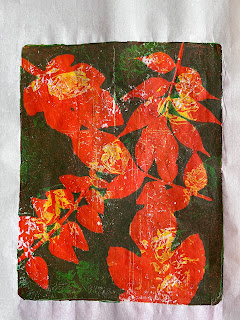
I have been printing lot recently using Gelli plates and acrylic paint. I love the gel plate to print with. It holds the paint nicely and doesn't dry the paint too quickly. Anyhow should the paint dry too fast its not a disaster. Lay a thin coat of transparent medium and you can pull the print. Or a thin layer of white paint - if your paper is white of course.  I have also been thinking of how to use up all those prints. What I like doing is using the prints to cover boxes made from recycled carton. They are quite small but quite rigid at the same time but are also quite inexpensive.  Here is a selection of recent prints. As you can see it was made with leaves that I collected from the garden. Dark colour printed first with the leaves then red then yellow. I often use thick tissue paper to blot the paint which leaves a nice texture which I like.  This was a transfer from a magazine. You need to use high quality glossy photographs from the more expensive magazines like Vog...

Glass Bottles

Image
I made this screen print in three different colours, blue, red and turquoise. Take a look, tell me which you prefer. Image size 30x20cm, paper size 50x35cm If you like them enough to buy, then contact me and we can arrange it. So as you know the cost - well, I recon it's a reasonable price for a large scale print. €20 euros each or three (one of each) for €50 euros. Post and packing €10 euros worldwide. Only with PayPal as it's the most secure for everyone. Anyway let me know what you think. Love to hear from you. mcloughlinhelen7@gmail.com

Colour Experiments

Image
As you can see, the screenprint comes in different colour ways. I think its fun to experiment, try turning the screen around for example. Of course if you buy one of these prints it wont have the copyright watermark, that goes without saying.  Let me know what you think. Do you like it? If not why not? I'm always interested in feedback or questions.  This is one from the series  " The Woods ".  It was inspired by a photograph taken in Cornwall UK one winter's day.  Paper dimensions: Image dimensions: Price: €60 Postage and packing Europe: €15 Postage and packing rest of world: €25 The © watermark will not be on the purchased print.