Posts

Showing posts with the label #Gelliart

Which Acrylic Paints for Gel Painting?

Image
Which paint for Acrylic painting on Gel Plates? Liquitex? Pēbeo? Amsterdam? Inexpensive Brands?   Choose the Best you can afford.  Acrylic paint can be cheap or expensive depending on the quality available. If you think you are going to like gel printing then go for a medium range of paint. I have bought cheap paint but I find it can be made with chemicals that smell or it contains mediums which take a while to dry or don’t mix well with other paints. Eventually I decided cheap is more expensive in the long run. I personally find Liquitex paints are good quality, reasonably priced, dry quickly and mix well. They also make all sorts of mediums and all their products are guaranteed to mix together. This is important as I have had issues before with certain brands of paints not mixing with other brands and I had to throw out a whole batch of paint. Now I stick with Liquitex. But if you find other brands for example Pēbeo or Amsterdam paints, no worries. They are good quali...

Collage with Gel Prints

Image
Create unique collages with gel prints. Fun ideas for journals, wall art, cards, and mixed media projects. I first started making collages with gel prints because I couldn’t bear to throw away all the little scraps of colour and texture I had pulled from my gel plate. Over time, I discovered that collage is one of the most rewarding ways to use these prints. Every torn or cut piece, every overlapping layer feels like building a puzzle where the pieces don’t quite match but somehow still fit together perfectly.  What I love most is the freedom—there are no rules. Sometimes I cut bold, bright prints into chunky shapes for a striking effect. Other times I cut softer pastel scraps, layering them to create depth and mood. The unexpected combinations always surprise me, and that’s where the magic happens. Here are a few ways I use my gel print collages: As wall art, creating big abstract pieces that feel both playful and expressive. I ofter start with a screen print or lithographic print...

Playing with Gel Prints and Collage

Image
  One of the things I love most about gel printing is the element of surprise. You roll on some paint, maybe add a stencil or press in a texture, pull the paper off the plate—and suddenly you’ve got something completely unexpected. Sometimes the print is gorgeous on its own, but a lot of the time I end up with papers that feel more like “hmm, interesting.” And that’s where collage comes in. Why They Work So Well Together Gel prints make the best collage material. All those textures, smudges, and layers of color become these beautiful little building blocks. Even the “not-so-pretty” prints take on new life when you rip them up and layer them with others. It’s like every scrap has potential—you just need to find where it fits. Here’s how I usually do it. Grab your print papers – The more variety, the better. Tear or cut – Sometimes I go for rough edges, sometimes clean shapes.  Play around – I move pieces around on my base until it starts to look reight. try to get a balance. I...

Cover boxes with Acrylic Prints

Image
 I have lots of acrylic prints so here is a suggestion for using the prints to cover inexpensive recycled boxes made from carton. So long as your box is not too big, most standard gel prints will be big enough to cover a small box. I usually use a second print for the inside or some nice paper like old music sheets.  For example, choose your print for the outside and if you are careful with your measurements you will have enough for the whole box.  Sometimes you might need to add a little piece here and there, but if you choose well it will not be noticed. As for the inside you can have either a similar colour or pick a contrasting colour which makes the insides pop a bit.  I don't even throw out the scraps of paper, unless of course they are too small to do anything with. I have used up lots of cut up bit to make a sort of patchwork cover for bigger boxes. If I need a larger print, well, I make two prints using exactly the same colours, that way I know they will mat...

Gel Printing for Beginners

Image
  Gel Printing for Beginners: Unlocking Creativity with Colour and Texture Gel printing is an exciting, beginner-friendly art technique that blends colour, texture, and creativity into a single process. Using a gel plate—a soft, flexible surface—you can easily create unique prints for cards, scrapbooking, or mixed-media art. Here’s how to get started!   Materials You'll Need  Acrylic paints and alcohol inks are perfect for gel printing. Acrylics offer bold, opaque coverage, while alcohol inks create translucent, vibrant effects. Other essentials include a brayer (roller), paper or fabric to print on, and tools to create texture.   Creative Stencil Ideas Stencils are a must for adding pattern and depth. You don’t need expensive ones—make your own! Cut shapes from card stock, repurpose plastic packaging, or use household items like lace, leaves, or bubble wrap for unique patterns.   How to Gel Print  1. Squeeze a small amount of acrylic paint onto t...

Gelli or Silicone for acrylic printing

Image
 Gelli Prints - on Gelli plate or silicone plate? If you want any sort of large size print you need to either join several prints together or Get a big gel plate. Now gel plates are expensive. There are lots of recipes for gel plates but I think most are either difficult to make or don't last long. I bought a Gelli plate that measures 20 x 25 cm and I find it excellent. If I clean it properly after use and store it properly then its as good as new for the next time.  However I want to try printing larger than 20 x 25 cm. So I have bought a silicone mat. Its 1.5 cm thick so should have a bit of "give" in it. 

Some recent work

Image
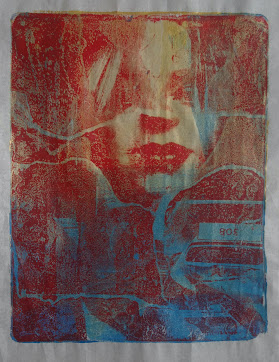
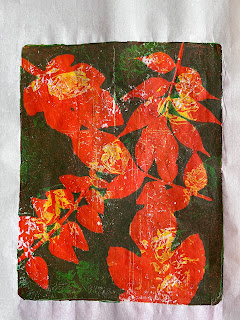
I have been printing lot recently using Gelli plates and acrylic paint. I love the gel plate to print with. It holds the paint nicely and doesn't dry the paint too quickly. Anyhow should the paint dry too fast its not a disaster. Lay a thin coat of transparent medium and you can pull the print. Or a thin layer of white paint - if your paper is white of course.  I have also been thinking of how to use up all those prints. What I like doing is using the prints to cover boxes made from recycled carton. They are quite small but quite rigid at the same time but are also quite inexpensive.  Here is a selection of recent prints. As you can see it was made with leaves that I collected from the garden. Dark colour printed first with the leaves then red then yellow. I often use thick tissue paper to blot the paint which leaves a nice texture which I like.  This was a transfer from a magazine. You need to use high quality glossy photographs from the more expensive magazines like Vog...

I'm back!

Image
 Hey, I'm back! Again?  😁 Ok I have been out of touch for a bit, Ha a bit sez you! More like a bit much.  But hey ho, here I am.  So now I am full of ideas and energy and I have been hard at work. I got really into Gelli printing recently so I will start with that.  First what is Gelli printing. Easy, its printing mono prints on a plate made from a type of glycerine. Wow cool. Yes its fun too. I bought the gel plate from Gelli Arts or on Amazon and you can suss it out here and see if you like the idea. Personally I love it. There is so much you can do, so many different textures and transfers you can make. And you use acrylic paint which means it dries really fast. Although if you want to slow it sown you can with a slow dry medium. But don't worry I'll take you through all the steps and before you know it you will be having great fun and coming up with all sorts of ideas for your own work.  Here is a sample of one of my prints. It's a photo transfer from ...